Skip to content
July 27, 2026
Rolarian News
  • Home
  • Crypto Updates
  • Ethereum Upgrades
  • Layer-2 and Scaling
  • Web-3
  • Contact
  • AI Updates
  • Testimonials
July 27, 2026
  • Home
  • Crypto Updates
  • Ethereum Upgrades
  • Layer-2 and Scaling
  • Web-3
  • Contact
  • AI Updates
  • Testimonials
Rolarian News
A close-up, over-the-shoulder photograph in a bustling Manila marketplace shows a hand holding a smartphone scanning a QRPh code on a small plastic stand at a sari-sari store counter. The phone screen displays a successful transaction confirmation interface, showing a dynamic conversion of Bitcoin (indicated by a subtle icon on the screen near the QR) into Philippine Pesos for a merchant payment. The background shows a lively Philippine market scene at golden hour.

Coins.ph Expands Crypto Payments, Lets Users Spend BTC and ETH via QRPh Nationwide

MANILA — Coins.ph has expanded its QRPh-enabled payment system to let users pay with Bitcoin and Ethereum at about 700,000

Read More


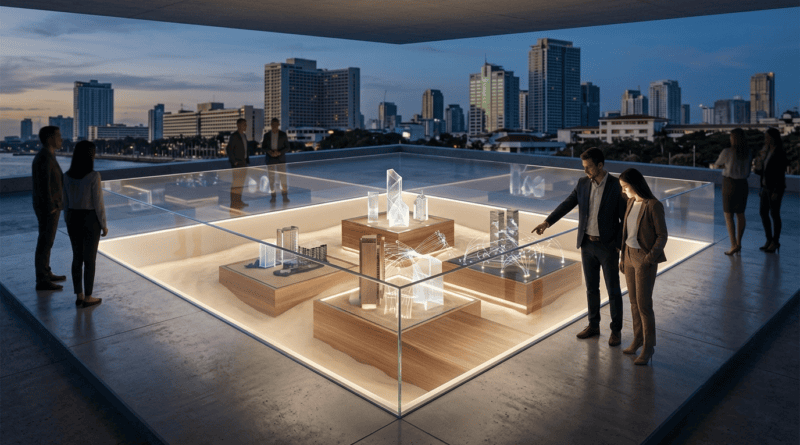
An editorial photograph of a modern, glass-walled observation deck overlooking the illuminated skyline of Manila at dusk, symbolizing the regulated 'SEC sandbox' environment. Two business professionals, a man and a woman in tailored suits, stand over a large, illuminated display table. Inside the glass-encased table, glowing holographic miniature structures of buildings and digital networks are under development within real sand, representing crypto asset intermediary technology. The scene has a high-tech, cinematic quality with soft ambient light, capturing a moment of serious analysis and collaboration. Other professionals are blurred in the background, out of focus. The focus is sharp on the central display and the foreground subjects. The mood is sophisticated, focused, and futuristic but grounded in a specific city environment.}

Binance partners with BlockShoals to pursue regulated Philippines return through SEC sandbox

MANILA — Binance has partnered with BlockShoals Technologies Inc. to support a regulated return to the Philippines through the Securities

Read More
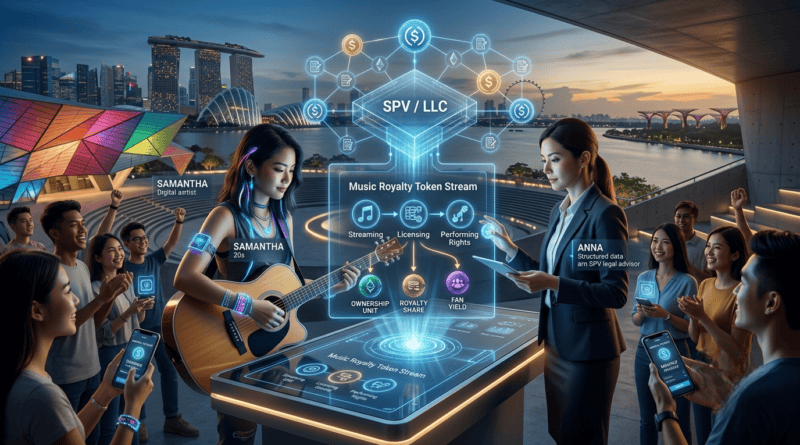
A high-end editorial, wide shot depicting a hybrid Web3 music concept set against the modern Southeast Asian skyline of Marina Bay, Singapore during sunset. In the center, a young female musician plays an acoustic guitar over a sleek, holographic interactive table that displays an illuminated, translucent flowchart tracking "Music Royalty Token Streams" from streaming, licensing, and performing rights. To the right, a professional legal advisor in a sharp blazer interacts with the digital interface, which highlights secure "SPV / LLC" wrappers and blockchain nodes. Surrounding them, an engaged group of young fans and investors hold smartphones displaying digital wallets with stablecoin balances, illustrating a collaborative, real-time fan economy. The lighting is cinematic, casting vibrant reflections across the modern outdoor pavilion.

Web3’s Next Big Hit: Tokenized Music Royalties and the New Fan Economy

Music tokenization has moved from experimental crypto culture into a serious Web3 entertainment model in 2026. What began as a

Read More
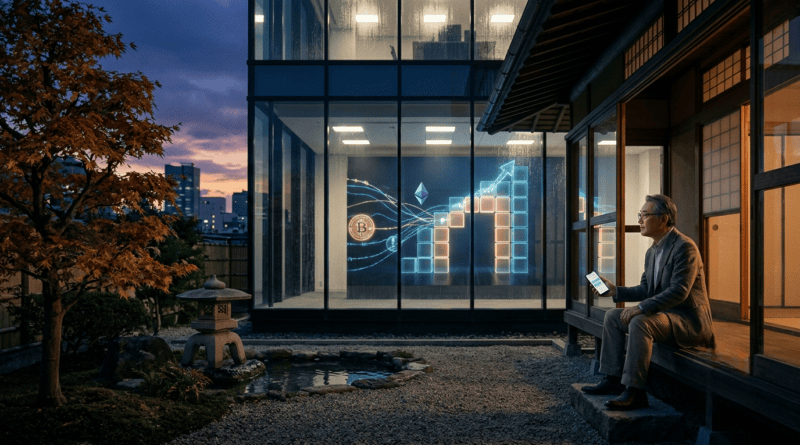
A hybrid editorial image showing a mature Japanese investor sitting on the porch of a traditional house with a stone garden at dusk. He is looking at his smartphone, which displays a financial app. Adjacent to the house is a modern glass office building, inside of which a large glowing digital display shows abstract financial charts, a rising bar graph, and floating holographic symbols of Bitcoin and Ethereum. The scene blends traditional Japanese architecture with advanced digital finance under a cinematic twilight sky.

SBI Securities, Rakuten Securities eye crypto trusts in Japan

TOKYO – Japan’s SBI Securities and Rakuten Securities plan to launch cryptocurrency investment trust products that would give retail investors exposure

Read More
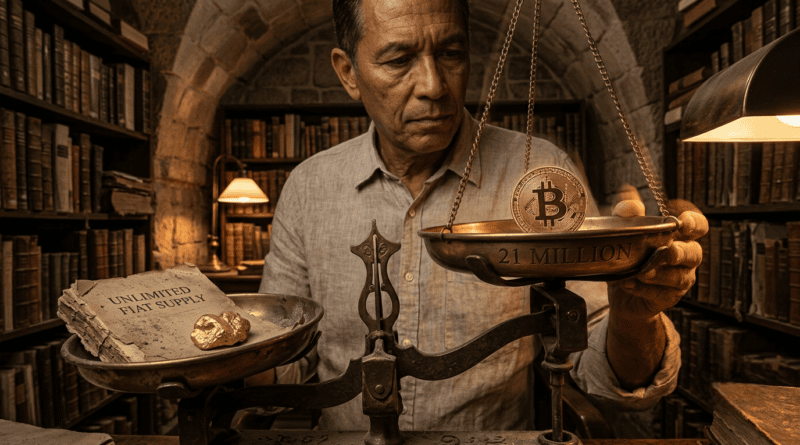
An editorial-style, close-up photograph of an older Southeast Asian macro trader in a dimly lit, historic stone archives room filled with floor-to-ceiling bookshelves. The man thoughtfully operates a heavy, vintage brass balance scale. On the right pan, which is tipped down in favor, sits a pristine, gleaming gold Bitcoin coin engraved with "21 MILLION". On the left pan rests a weathered piece of parchment reading "UNLIMITED FIAT SUPPLY" alongside a raw gold nugget. The scene is illuminated by warm, dramatic low-key lighting from a brass desk lamp, creating an atmosphere of meticulous evaluation and financial philosophy.

Paul Tudor Jones says bitcoin is ‘unequivocally the best inflation hedge’

NEW YORK — Billionaire investor Paul Tudor Jones said bitcoin is “unequivocally the best inflation hedge” and argued it offers

Read More
NFTs for music tokenization are changing how artists, fans, and the music business think about ownership, access, and value. In simple terms, they let music be turned into a digital asset that can be sold, shared, or used to prove ownership and support artists more directly. What Music Tokenization Means Music tokenization means converting music-related rights or value into digital tokens on a blockchain. Those rights can include songs, albums, royalties, ownership shares, or access to special fan benefits. This means a song can become more than something you stream on a phone. It can also become a digital item with traceable ownership, possible resale value, and a built-in record of who owns what. What an NFT Is in Music An NFT, or non-fungible token, is a unique digital item recorded on a blockchain. In music, an NFT can represent a song, an album, a concert ticket, a backstage pass, a fan membership, or a piece of collectible artwork connected to a musician. WIPO notes that NFTs can be used for music albums and other digital works, but the NFT itself is not the same thing as the copyright in the music. That means owning a music NFT does not automatically mean owning all legal rights to the song unless those rights are clearly included. How Music Tokenization Works The basic process is simple to understand. An artist creates music or music-related content. The music or related rights are turned into a digital token on a blockchain. The token is sold, shared, or held by fans, investors, or collectors. The blockchain keeps a record of ownership and transactions. This can help artists sell directly to fans and reduce dependence on traditional middlemen. It can also make royalty sharing more transparent and easier to track. Why NFTs Matter for Musicians NFTs give musicians new ways to earn money and build stronger fan relationships. A fan may buy a music NFT not only to support the artist, but also to receive something special, such as exclusive content, voting rights, or limited-edition access. This can be powerful for independent artists because it creates a more direct connection between creativity and income. Instead of waiting only for streaming revenue, artists can sell special digital products that fans value more personally. The Connection Between NFTs and Intellectual Property Intellectual property, or IP, means the legal rights that protect creative work such as songs, lyrics, recordings, album art, and logos. Music tokenization becomes more meaningful when IP is clearly defined, because the token may represent a song, a license, or a royalty share, but not always the full copyright. WIPO explains that copyright law still matters even when music is tokenized. If a sound recording or clip is used in an NFT, permission from the copyright holder may still be required. In other words, blockchain can help record ownership, but it does not replace the law. Why This Is Important for Ordinary People For ordinary listeners and young creators, music tokenization makes the music world easier to understand because it shows where value comes from and who benefits.It can help fans support artists more directly and give creators more control over how their work is shared.  For students and learners, it is a good example of how technology changes business and creativity at the same time. It shows that music is no longer only something you hear; it can also be something you own, collect, or help fund. Risks and Things to Understand Music NFTs are exciting, but they also need careful use. Not every NFT gives ownership of the music itself, and buyers should always check what rights are included. There are also practical questions about pricing, legal rules, royalties, copyright, and long-term value. So while music tokenization can create new opportunities, it works best when artists, fans, and platforms are clear about the rights involved. Conclusion NFTs for music tokenization are a new way to connect creativity, ownership, and fan support. They can help musicians raise money, share value with supporters, and make music ownership easier to track. At the same time, IP law still matters because the NFT is not the same as the copyright in the song. For ordinary people, the big idea is simple: music tokenization can make the music industry more direct, more transparent, and more interactive.

Music NFTs Made Simple: How Tokenization Is Changing the Future of Songs

NFTs for music tokenization are changing how artists, fans, and the music business think about ownership, access, and value. In

Read More
This candid editorial photograph captures an anxious Asian maritime logistics manager in his late 30s sitting at a cluttered desk in a modern Singapore office at twilight. He looks distressed, leaning his head on his left hand while staring intently at a laptop screen displaying a global shipping map and email data. His right hand rests near a maritime satellite phone. On his desk are notebooks, papers with a faint Bitcoin symbol, and a landline. Rain streaks across large windows in the background, which overlook a working container port and a cloudy sunset over the water with multiple cargo ships. Other blurred colleagues are working at their desks. The style is cinematic and realistic with dramatic warm and cool lighting.

Iran’s Bitcoin-backed Hormuz shipping payments could test crypto’s neutrality claims

Iran’s reported move to use bitcoin for shipping insurance and transit-related payments in the Strait of Hormuz is setting up

Read More
A female artist in a digital studio works on a tablet, with connecting blue holographic lines and text boxes labeled "CREATED: OCT 26," "ORIGIN PROVED," "IP REGISTERED," and "DIGITAL NOTEBOOK," illustrating blockchain and digital trust in intellectual property.

Blockchain and Intellectual Property: How Digital Trust Is Changing Creative Ownership

Blockchain is making it easier to prove who created something, when it was created, and how it moves from one

Read More
A high-end editorial conceptual photograph set on a balcony overlooking the Tokyo skyline at twilight. In the foreground, a prominent crystalline handshake sculpture is made of interwoven glowing fiber optic cables and geometric data points. One hand is clearly marked with the debossed Japanese characters for 'cooperation' (協力) and an abstract Japanese flag pattern, while the other features a colorful tapestry representing diverse international partners. Inside the transparent hands, tiny symbols of cyber defense shields and stabilized data streams are visible, actively filtering and neutralizing a chaotic stream of pixelated malicious code fragments attempting to infiltrate from above. The Tokyo Skytree and other city landmarks are lit in the soft, purple and orange hues of dusk. A group of diverse diplomats is visible but blurred in the background, adding context to the scene, while the focus remains on the complex and meaningful handshake sculpture. The image has a cinematic, high-detail finish with no visible text or logos.

Japan Moves to Strengthen Global Cooperation on AI Risks

Japan is stepping up its push for international coordination on AI safety, with officials highlighting cyberattacks, misinformation, and other emerging

Read More
A close-up conceptual image from an over-the-shoulder perspective looking past a person's hand toward a glowing, fractured stream of data network lines representing an AI system. A heavy, dark hand wearing a cufflink shaped like a classical government building's facade grips and squeezes the glowing digital conduit, attempting to seal a break where red sparks and fractured code leak out. The scene is set inside a high-end corporate office or server room with a large window showing a blurred

White House Pushes Anthropic to Seal AI “Jailbreaks” as Frontier Model Fight Escalates

The White House is pressuring Anthropic and other frontier AI companies to make their most advanced models resistant to every

Read More
  • ← Previous
  • Next →

Copyright © 2026 Rolarian News.